How to launch an AI tool in a crowded category
A working method for founders shipping "another" AI writing, notes or chatbot tool. You leave with a rewritten one-line claim and a plan for the evidence behind it.
By the CodeTrendy Editorial Team. Published , revised . 19 minute read, 14 sources.
The short answer
How do you launch an AI tool when the category is already full of similar products?
Stop leading with AI. Pick one job, for one kind of user, inside one workflow, and write a one-line claim with a number and a condition that a stranger could test. Then publish the proof: an unedited demo, a reproducible benchmark and a plain list of where the tool fails. In the 2025 Stack Overflow survey, more developers distrusted AI output (46%) than trusted it (33%)[1].
- Time needed
- 1 day for the claim, 1 to 2 weeks for proof
- Cost
- Mostly your own time
- Best for
- AI tools with many lookalikes
- You leave with
- A one-line claim and a proof plan
What you will leave with
- Why "AI-powered" tells a buyer nothing, with the survey figures on how little AI output is trusted.
- How to pick a wedge: one job, one user, one workflow, scored on how painful the job is and how well you can prove you do it.
- A fill-in template for a claim that names a task, a number, a condition and a limit.
- Five kinds of proof, what each costs to produce, and how each one can backfire.
- The AI claims the US Federal Trade Commission has taken action over, and the evidence standard it applies to all advertising.
Why does "AI-powered" no longer set a product apart?
Because nearly everyone already uses AI tools, and most people do not trust what those tools produce. The label describes the whole category, so it cannot describe you.
A differentiator has to be true of you and not of the alternatives. In the 2025 Stack Overflow Developer Survey, 84% of respondents said they use or plan to use AI tools in their development process, up from 76% the year before[1]. Saying you use it is like a restaurant advertising that it has a kitchen.
Adoption did not bring trust with it. The same survey found favourable sentiment toward AI tools at about 60%, down from more than 70% in 2023 and 2024[1]. People keep using tools they only half believe. That gap is your opening.
- of developers distrust the accuracy of AI tool output; 33% trust it (2025)[1]
- 46%
- of developers report the frustration "AI solutions that are almost right, but not quite" (2025)[1]
- 66%
- of US adults are more concerned than excited about the increased use of AI in daily life (surveyed August 2024)[3]
- 51%
- of people across 47 countries are willing to trust AI systems (data collected November 2024 to mid-January 2025)[4]
- 46%
Figure 1How much developers trust the accuracy of AI tool output, 2025
Highly trust
3.1%Somewhat trust
29.6%Somewhat distrust
26.1%Highly distrust
19.6%
Read those numbers with their scope. The Stack Overflow results come from 49,009 responses in 177 countries, fielded from May 29 to June 23, 2025, and respondents were recruited mainly through channels Stack Overflow owns[2]. That is a large sample of Stack Overflow's audience, not a random sample of developers or of your buyers.
What do users and buyers worry about with AI products?
Wrong answers that look right, and not being in control. Both worries show up in developer surveys and in general-population surveys, and both can be answered on a product page.
Figure 2Feelings about the increased use of AI in daily life: US adults vs AI experts
US adults: more concerned than excited
51%AI experts: more concerned than excited
15%US adults: more excited than concerned
11%AI experts: more excited than concerned
47%
The Pew figures come from a survey of 5,410 US adults in August 2024 and a separate survey of 1,013 AI experts living in the US between August and October 2024; the expert responses are unweighted and represent only those who answered[3]. Founders sit on the expert side of that gap and write for the other side.
Figure 3What the surveys found, and what to put on your page in response
| Finding | Who was asked | What to show (our suggestion) |
|---|---|---|
| 66% chose "AI solutions that are almost right, but not quite" as a frustration[1] | Who was askedDevelopers, Stack Overflow survey, 2025 | What to show (our suggestion)Your measured error rate on a named task, and how a user spots an error quickly. |
| 75.3% would still ask another person "When I don't trust AI's answers"[1] | Who was askedDevelopers, Stack Overflow survey, 2025 | What to show (our suggestion)A human path: review step, export, support contact, or a way to see the source material. |
| 66% of US adults and 70% of AI experts report a high level of concern about inaccurate information from AI[3] | Who was askedUS adults and US-based AI experts, 2024 | What to show (our suggestion)Citations or links back to the input for every generated statement, where the product allows it. |
| 55% of US adults and 57% of AI experts want more control over how AI is used in their lives[3] | Who was askedUS adults and US-based AI experts, 2024 | What to show (our suggestion)Visible controls: what is sent to the model, what is stored, and how to turn a feature off. |
How do you find a narrow wedge in a crowded AI category?
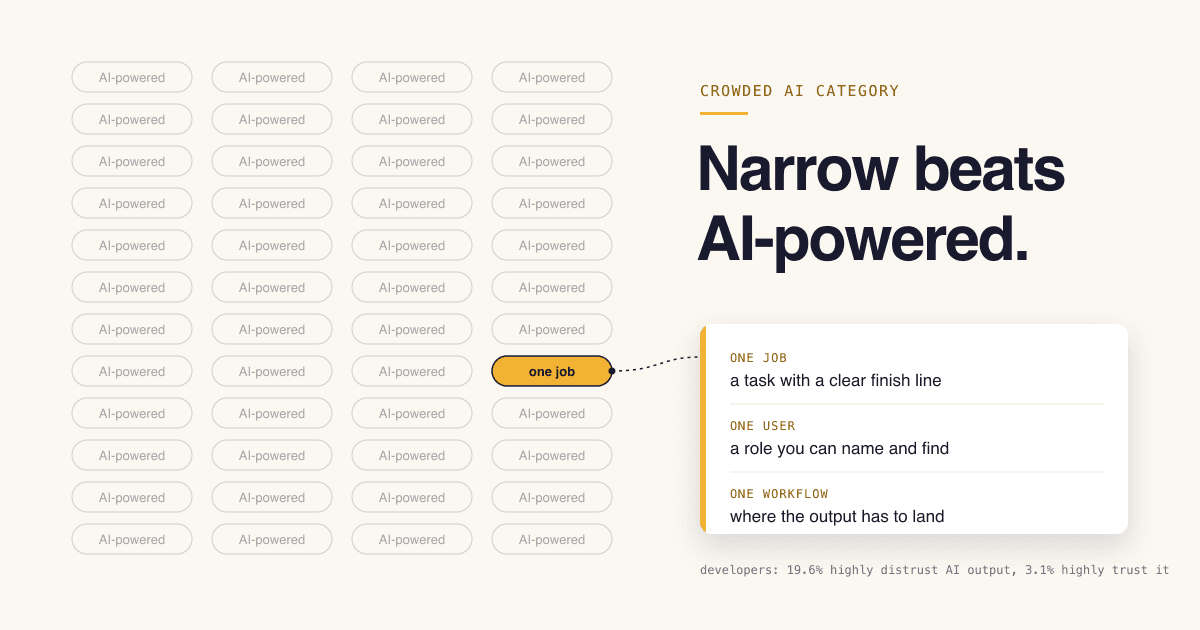
Choose one job, for one kind of user, inside one workflow, where the job hurts and you can show you do it well. Narrow enough that a competitor with a general tool sounds vague next to you.
April Dunford breaks positioning into five components: competitive alternatives, differentiated features or capabilities, value for customers, target customer segmentation, and market category[5]. She starts from the alternatives, which include a customer doing nothing at all. For an AI tool the honest list is usually short: a general chatbot, the incumbent app that just added an AI button, and doing the task by hand.
The method below is ours. A wedge is the smallest combination of job, user and workflow where you beat all three of those alternatives on something a user can see.
The three parts of a wedge
- One job
- A task with a clear finish line. "Turn a recorded sales call into a CRM update" is a job. "Boost productivity" is not.
- One user
- A role you can name and find, such as "solo bookkeepers with 20 to 60 clients". If you cannot list ten of them by name, it is still too broad.
- One workflow
- The tools and the moment the job happens in. Where the input comes from, and where the output has to land for the job to count as done.
Figure 4Choosing a wedge: how painful is the job, and can you prove you do it?
Costly or dreaded How painful the job is, Hard to show How provable your result is
Promising, not ready
Painful job, but you cannot yet demonstrate the result. Build the measurement before you launch on this.
Costly or dreaded How painful the job is, Easy to show How provable your result is
Launch hereStart here
Painful job and a result anyone can check in minutes. Lead with this single use case.
Mild annoyance How painful the job is, Hard to show How provable your result is
Drop it
Nobody minds much and you cannot show the gain. This is where "AI-powered" copy comes from.
Mild annoyance How painful the job is, Easy to show How provable your result is
Demo, not a business
Easy to show, but nobody loses sleep over it. Use it as a hook, not as the claim.
Is your wedge narrow enough?
If A general chatbot does the job acceptably with a good prompt
Move to a workflow where the input, output or integration is the hard part, not the text generation.
If Your claim would still be true if you swapped in a competitor's name
Narrow the user or the job until it stops being true of them.
If You can measure the result on real input in under a day
Narrow enough. Go and write the claim.
How do you write an AI product claim that is specific and checkable?
Name the task, the user, a number, the conditions the number holds under, and one limit. If a sceptical stranger could not test the sentence in ten minutes, it is not a claim yet.
Vague (invented example: "NoteGenie")
- "AI-powered meeting notes that supercharge your team."
- No user and no task: "notes" could mean a transcript, a summary or action items.
- No number and no conditions, so nothing can be tested.
- Equally true of every other tool in the category.
Specific (invented example: "Ledgerline Notes")
- "Turns a recorded client call into a filled-in bookkeeping follow-up email in under 2 minutes. English calls up to 60 minutes. You approve every email before it sends."
- One user and one task with a finish line: the follow-up email exists.
- A number and its conditions: under 2 minutes, English, up to 60 minutes.
- A limit and a control: nothing sends without approval.
The call: Both products are made up for this guide, and so are the numbers. The second is longer and will put some people off. That is the job: the right reader recognises their own week, and you have a sentence you can prove.
One-line claim template
Fill in every bracket with something you have measured. If a bracket stays empty, that is the next thing to go and measure.
[Product] turns [specific input] into [specific finished output] for [one named kind of user] in [measured time or accuracy], when [conditions: language, size, source, plan].

It does not [the most likely thing a buyer would wrongly assume].

Check it yourself: [link to demo, sample files or benchmark].
Four tests for the finished sentence
- The swap test Put a competitor's name in. If the sentence is still true, it is not positioning.
- The stranger test Could someone who has never met you verify it in ten minutes with what is on the page?
- The worst-day test Is it true for a typical user on typical input, not only for your best run?
- The 100-character test Can the core of it fit a directory tagline? On CodeTrendy the tagline field holds up to 100 characters, so the task and the user have to survive that cut.
How do you prove an AI product claim?
Show the product working on real input, publish how you measured the number, and list where it fails. Proof a reader can run themselves beats proof they have to take on faith.
Figure 5Five kinds of proof for an AI product
| Proof type | What it is | Cost to produce | What it proves | How it can backfire |
|---|---|---|---|---|
| Unedited demo | What it isOne continuous screen recording of a real task, with the clock visible. | Cost to produceLow: a few hours | What it provesThe product does the task at the stated speed, once. | How it can backfireViewers assume a cherry-picked run. Say how the input was chosen. |
| Before and after | What it isThe raw input beside the finished output, both downloadable. | Cost to produceLow: a few hours | What it provesWhat "done" looks like, and how much editing is left. | How it can backfireA polished "after" that a human quietly fixed is a misleading claim. |
| Reproducible benchmark | What it isA published test set, the scoring rule, your score and the date. | Cost to produceHigh: days to weeks | What it provesA number that holds across many inputs, not just one. | How it can backfireTesting on narrow data and claiming a general result. See the Workado case below. |
| Limits page | What it isA plain list of inputs, languages and cases the tool handles badly. | Cost to produceLow: an hour, if you are honest | What it provesThat you know your product, and that the rest of your page can be believed. | How it can backfireAlmost never, unless it is buried or contradicted by the headline. |
| Try it without signing up | What it isA sandbox with sample data, or a free run on the reader's own file. | Cost to produceMedium to high: engineering time and model costs | What it provesEverything, to the one person trying it. | How it can backfireA bad first output on an unusual file is the only impression you get. |
How to rewrite your claim and build a proof plan
List the real alternatives30 min
Write down what your user does today: a general chatbot, an incumbent's AI feature, a manual process, or nothing. These are the things your claim has to beat.
Score three candidate wedges1 hour
For each, name the job, the user and the workflow, then place it on the pain and provability matrix above. Keep one.
Measure before you writeHalf a day
Run the product on at least 20 real inputs from that wedge. Record time, how many outputs needed no edits, and every failure. Twenty is our suggested floor, not a statistical standard.
Fill in the template30 min
Use the measured figures, with their conditions. Round down, not up. Add the one thing the product does not do.
Pick two proofs and a limits page1 to 2 weeks
One cheap proof you can ship this week (demo or before and after) and one strong one to build (benchmark or try-it). Write the limits page the same day.
File the evidence1 hour
Keep the inputs, outputs, scoring and dates behind every number on the page. Re-run the measurement after each model or prompt change.
Which AI claims must you not make?
Any objective claim you cannot back with evidence you already hold. In the US that is ordinary advertising law, and the FTC has applied it to AI products by name.
There is no special AI rulebook to learn first. The FTC's advertising guide for small businesses states the baseline: advertising must be truthful and non-deceptive, advertisers must have evidence to back up their claims, and the law requires that proof before the ad runs[6]. That covers implied claims as well as express ones, so a hero image or a product name can make a claim your sentence carefully avoided[6].
In September 2024 the agency announced five law enforcement actions under the name Operation AI Comply[7]. The table reports what the FTC alleged in its complaints and what its press releases say happened next. Allegations are not findings, three of the cases were still before a court when the FTC described them, and none of this is legal advice.
The FTC's enforcement actions make clear that there is no AI exemption from the laws on the books.
Figure 6FTC actions over AI product claims: the allegation and the status the FTC reported
| Company | The claim, as the FTC described it | What the FTC alleged | Status reported by the FTC |
|---|---|---|---|
| DoNotPay | The claim, as the FTC described itPromoted as "the world's first robot lawyer", promising to "generate perfectly valid legal documents in no time"[7] | What the FTC allegedThe complaint alleged the company did not test whether the chatbot's output matched the level of a human lawyer, and did not hire or retain attorneys[7] | Status reported by the FTCSettled. Final order announced February 11, 2025: $193,000 in monetary relief, notice to 2021 to 2023 subscribers, and no advertising that the service performs like a real lawyer without sufficient evidence[8] |
| Workado | The claim, as the FTC described itAI Content Detector promoted as "98 percent" accurate at telling AI text from human text[9] | What the FTC allegedThat the claim was false, misleading or unsubstantiated. According to the complaint, independent testing showed 53 percent accuracy on general-purpose content[9] | Status reported by the FTCSettled. Proposed order announced April 28, 2025, subject to public comment: no effectiveness claims without competent and reliable evidence, keep that evidence, email eligible consumers, file compliance reports[9] |
| Ascend Ecom, Ecommerce Empire Builders, FBA Machine | The claim, as the FTC described itOnline storefront schemes sold with AI-powered tools and promises of passive, large or guaranteed income[7] | What the FTC allegedFalse or unsupported earnings claims. For Ecommerce Empire Builders, that it had no evidence for ads saying clients can make $10,000 monthly. The FTC put consumer losses at $25 million or more for Ascend and more than $15.9 million for FBA Machine[7] | Status reported by the FTCLawsuits filed in federal court (FBA Machine in June 2024, the other two announced in September 2024). Courts temporarily halted each scheme; the FTC described all three cases as ongoing in September 2024[7] |
| Rytr | The claim, as the FTC described itAn AI writing assistant with a "Testimonial & Review" generation feature[7] | What the FTC allegedThat it gave subscribers the means to generate false and deceptive consumer reviews[7] | Status reported by the FTCFinal consent order in 2024, then reopened and set aside on December 22, 2025. The FTC said the facts alleged did not support a violation of the FTC Act and that the order unduly burdened AI innovation[10] |
Claims to cut from your page, based on those cases
- Avoid: An accuracy figure without the test behind it If you say 98%, hold the test that produced it, and run that test on the kind of content your customers actually use. The FTC alleged that Workado's model was tuned only for academic content while the product was sold for general use[9].
- Avoid: "Replaces a lawyer, doctor, accountant or analyst" Only if you have tested the output against that professional's work and can show it. The DoNotPay order bars claims that the service performs like a real lawyer without sufficient evidence[8].
- Avoid: Income or savings promises Any "earn $X a month with our AI" line is an objective claim, so it needs evidence you hold before it runs[6]. Unsupported earnings claims are what the FTC alleged against all three storefront schemes[7]. Our advice: quote what a typical customer gets, not your best one.
- Avoid: Reviews or testimonials nobody wrote An FTC rule announced in August 2024 prohibits fake reviews and testimonials, and names AI-generated fake reviews specifically[11].
- Avoid: "AI" for something that is not In our reading, calling a rules engine or a human back office "AI" is a plain factual claim about how the product works, and it falls under the same truthful-and-evidenced standard[6].
Where should you launch an AI tool?
Where your one named user already spends time, and where people can try the product rather than read about it. Two or three places done properly beat twenty drive-by posts.
Channel choice follows from the wedge. A tool for bookkeepers launches in bookkeeping communities first and on general launch sites second. For the full list of places, their rules and costs, use where to promote your startup; this section only covers what changes when the product is an AI tool in a crowded category.
Three things to respect
- Hacker News (Show HN) Show HN is for something you have made that other people can play with. Landing pages, sign-up pages and blog posts are off topic, and the rules say not to ask friends to upvote or comment[13]. A specific claim plus a no-signup demo is the format the rules already ask for.
- Product Hunt Its launch guide says the best day to launch is the day you are most prepared, that makers can hunt their own product, and that you cannot ask people directly to upvote[14]. Your tagline there is your one-line claim, so finish the claim first.
- Directories and category pages A listing puts you beside your lookalikes, which is where a specific claim does the most work. On CodeTrendy you pick one category and the form suggests the niche rather than the broadest match; browse categories and alternatives pages to see who you will sit next to.
What mistakes sink a launch in a crowded AI category?
Launching on the technology, launching to everyone, and publishing numbers you cannot stand behind. When the wedge is not found yet, the right move is not to launch.
- Avoid: Naming the model as the benefit Which model you call is an implementation detail your competitors can copy in an afternoon. It belongs in the "how it works" section.
- Avoid: A demo on your own perfect input Readers have been burned by "almost right" output[1]. Use a messy, realistic input and leave the flaws in.
- Avoid: Quoting a benchmark from a different task A score on academic text says nothing certain about marketing copy. This is the mismatch the FTC alleged in the Workado case[9].
- Avoid: Launching before the wedge exists If the decision rules above keep sending you back to interviews, do the interviews. A product only gets one first launch.
Claim and proof checklist before you launch
0 of 11 done
The claim
The proof
The honesty pass
5 quick answers
Common questions
Short answers to the follow-up questions readers ask most.
Not here? Ask usNot necessarily. People search for AI tools by that word and directories categorise by it, so it helps you get found. The problem is using it as the benefit. Keep it as a category label, and spend the main sentence on the task, the user and the measured result. That is our judgement, not a survey finding.
Sources
- [1]2025 Developer Survey: AIStack Overflow, 2025
- [2]2025 Developer Survey: MethodologyStack Overflow, 2025
- [3]How the U.S. Public and AI Experts View Artificial IntelligencePew Research Center, 2025
- [4]Trust, attitudes and use of artificial intelligence: A global study 2025University of Melbourne and KPMG, 2025
- [5]A Quickstart Guide to PositioningApril Dunford, 2021
- [6]Advertising FAQ's: A Guide for Small BusinessFederal Trade Commission
- [7]FTC Announces Crackdown on Deceptive AI Claims and SchemesFederal Trade Commission, 2024
- [8]FTC Finalizes Order with DoNotPay That Prohibits Deceptive 'AI Lawyer' Claims, Imposes Monetary Relief, and Requires Notice to Past SubscribersFederal Trade Commission, 2025
- [9]FTC Order Requires Workado to Back Up Artificial Intelligence Detection ClaimsFederal Trade Commission, 2025
- [10]FTC Reopens and Sets Aside Rytr Final Order in Response to the Trump Administration's AI Action PlanFederal Trade Commission, 2025
- [11]Federal Trade Commission Announces Final Rule Banning Fake Reviews and TestimonialsFederal Trade Commission, 2024
- [12]Article 50: Transparency Obligations for Providers and Deployers of Certain AI SystemsEU Artificial Intelligence Act (Future of Life Institute explorer)
- [13]Show HN GuidelinesHacker News (Y Combinator)
- [14]Product Hunt Launch GuideProduct Hunt
How this guide was put together. Every figure, quotation and case on this page was checked against the text of the linked source on 11 October 2026. The FTC pages and the Product Hunt guide were read from archived copies of the same URLs, because both sites refused automated requests that day. Survey numbers are reported with the population and year they describe: Stack Overflow respondents are developers recruited mainly through its own channels, the Pew expert sample is unweighted, and none of these surveys measured buyers of your product. The FTC section reports the agency's own press releases and small-business guidance: it describes allegations and orders as the FTC worded them, the storefront cases are described as they stood in September 2024, and we did not check court dockets for later developments. The EU AI Act date comes from an unofficial explorer, not the Official Journal. The wedge method, the claim template, the proof table, the cost estimates and the checklist are editorial judgement, not research findings.