How to get cited by AI search: what the evidence says
An evidence-first guide for founders of small product sites: what the vendors document, what one much-quoted research paper really tested, which tactics are unproven, and a weekly method for checking whether AI answers cite you.
By the CodeTrendy Editorial Team. Published , revised . 17 minute read, 12 sources.
The short answer
How does a small product site get cited in AI answers?
AI answer engines cite pages their search index retrieved for the question, so the documented requirements are plain: let each engine's search crawler in, be indexed, and publish text that answers a specific question with checkable facts. Vendors document no special markup or file that earns a citation. Research supports adding sourced statistics and quotations. Everything else is unproven, so measure it yourself with weekly prompt checks.
- Time needed
- About 3 hours, then 40 minutes a week
- Cost
- Free
- Skill level
- Can edit pages and read analytics
- Best for
- Sites that are already indexed
What you will leave with
- Google states there are no additional requirements, special optimizations, schema or AI text files needed to appear in AI Overviews or AI Mode beyond being indexed and snippet-eligible.[1]
- OpenAI, Perplexity and Anthropic each document a separate search crawler. Blocking it is a documented way to drop out of that engine's search answers.[7][8][9]
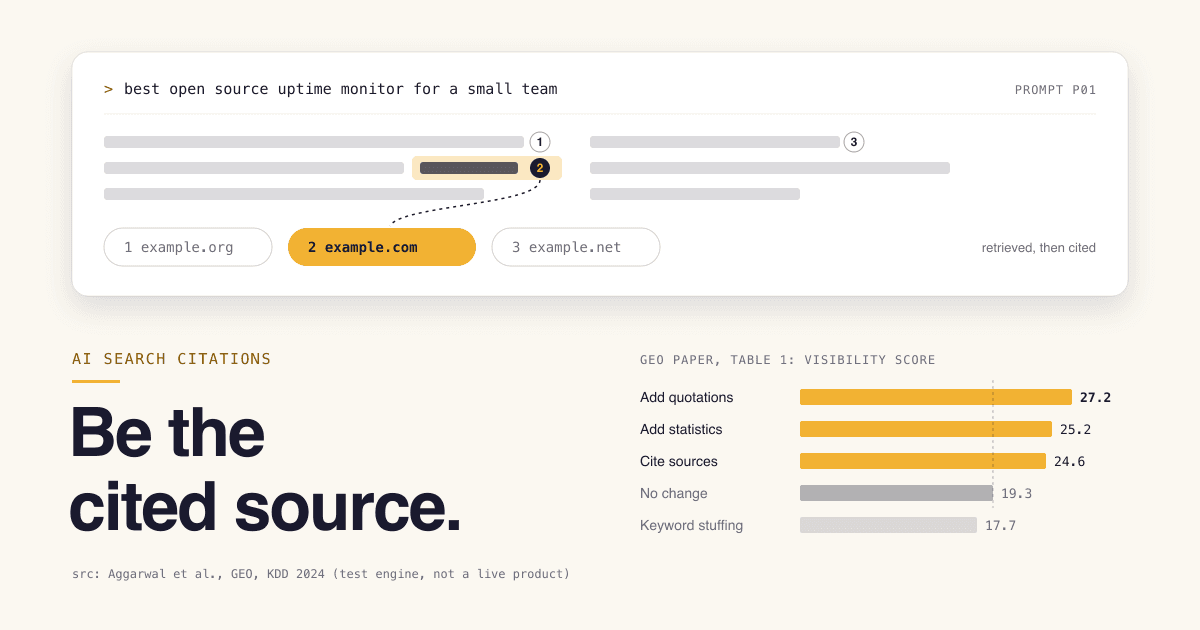
- The GEO paper found that adding quotations, statistics and cited sources raised visibility in a test engine, and that keyword stuffing lowered it. It was tested on a gpt-3.5-turbo pipeline and 200 Perplexity samples, not on today's products.[11]
- A citation is not a visit. In a Pew panel, users clicked a link inside an AI summary in 1% of visits to pages that had one.[12]
- A fixed set of 10 prompts, run weekly on the same engines and logged in a sheet, tells you more than any single screenshot.
What do AI answer engines actually retrieve and cite?
They run searches, pull a handful of pages from a search index, write an answer from those pages and link the ones they used. You are cited when your page is retrieved for the question and contains the passage the answer needed.
That makes citation a retrieval problem before it is a writing problem. A page that is not in the engine's index, or is not retrieved for the searches the engine runs, cannot be cited no matter how it is written.
The searches are not always the words the user typed. Google documents that AI Overviews and AI Mode may use a "query fan-out" technique, issuing multiple related searches across subtopics and data sources.[1] Bing calls the phrases its AI used to retrieve cited content "grounding queries" and shows a sample of them to site owners.[10]
- of Google searches by a US panel in March 2025 produced an AI summary[12]
- 18%
- of those AI summaries cited three or more sources[12]
- 88%
- of visits included a click on a traditional result, with and without an AI summary[12]
- 8% vs 15%
- of visits to pages with an AI summary included a click on a link inside the summary[12]
- 1%
Those figures come from Pew Research Center, which tracked the browsing of 900 US adults and analysed 68,879 Google searches.[12] They describe Google only, in one country and one month, but they set a useful expectation: most summaries cite several pages, and few readers click any of them. A citation is a link shown as a source, not a visit.
What does each vendor document about how it finds and cites pages?
Less than the GEO industry implies. Each vendor documents how its search crawler gets access and, in two cases, how to see citations. None documents a ranking formula for citations.
Figure 1Main AI answer surfaces and what the vendor documents, checked October 2026
| Surface | How it finds pages (documented) | What the vendor says you need | First-party reporting |
|---|---|---|---|
| Google AI Overviews and AI Mode | How it finds pages (documented)Google Search index. May use query fan-out across subtopics.[1] | What the vendor says you needPage must be indexed and eligible to be shown with a snippet. No additional requirements, no special schema, no AI text files.[1] | First-party reportingSearch Console generative AI performance report: impressions only, by page, country, date and device.[3] |
| ChatGPT search | How it finds pages (documented)OAI-SearchBot is used to surface websites in ChatGPT search features.[7] | What the vendor says you needOpenAI recommends allowing OAI-SearchBot in robots.txt. Opted-out sites are not shown in search answers, though they can still appear as navigational links.[7] | First-party reportingNone described on the page checked. |
| Perplexity | How it finds pages (documented)PerplexityBot is designed to surface and link websites in Perplexity search results.[8] | What the vendor says you needPerplexity recommends allowing PerplexityBot in robots.txt and permitting its published IP ranges.[8] | First-party reportingNone described on the page checked. |
| Microsoft Copilot and Bing AI summaries | How it finds pages (documented)Bing retrieves content using grounding queries.[10] | What the vendor says you needBing suggests clear headings, tables and FAQ sections, cited evidence, regular updates, and IndexNow to report changes.[10] | First-party reportingBing Webmaster Tools AI Performance: total citations, average cited pages, a sample of grounding queries.[10] |
| Claude with web search | How it finds pages (documented)Claude-SearchBot navigates the web to improve search result quality.[9] | What the vendor says you needDisallowing Claude-SearchBot prevents indexing of your content for search; disallowing Claude-User prevents retrieval in response to a user query.[9] | First-party reportingNone described on the page checked. |
Read the Google row twice. Its documentation says: "There are no additional requirements to appear in AI Overviews or AI Mode, nor other special optimizations necessary."[1] Its May 2025 advice post, by John Mueller of Google Search Relations, tells site owners to focus on unique, non-commodity content.[2]
Search and training are separate switches. OpenAI states each crawler setting is independent, with GPTBot covering training and OAI-SearchBot covering search.[7] Perplexity says PerplexityBot is not used to crawl content for AI foundation models.[8]
What did the GEO research paper actually find?
In a simulated answer engine, rewriting a page to add quotations, statistics and cited sources increased how much of the answer drew on it, and keyword stuffing reduced it. The result is real, narrow and now dated.
"GEO: Generative Engine Optimization" was published at KDD 2024 by authors listed at Princeton University and IIT Delhi, with two independent researchers.[11] It introduced the term generative engine optimization, and its abstract is the source of the much-repeated claim that GEO "can boost visibility by up to 40%".
The setup: a benchmark of 10,000 queries, each paired with the top 5 Google results. One randomly selected source was rewritten by a language model using one of nine methods, then an engine built on gpt-3.5-turbo generated an answer from the five sources. The headline metric was position-adjusted word count: the share of the answer's words that cite the source, weighted toward the top of the answer. A second score, judged by a language model, is also reported.[11]
Figure 2GEO paper, Table 1: overall position-adjusted word count by rewrite method
Quotation addition
27.2Statistics addition
25.2Fluency optimization
24.7Cite sources
24.6Technical terms
22.7Easy to understand
22Authoritative tone
21.3Unique words
20.5No optimizationBaseline
19.3Keyword stuffing
17.7
Figure 3GEO paper, Table 2: relative change in visibility by the Google rank of the rewritten page, among the five sources
| Method | Page ranked 1st | Page ranked 5th |
|---|---|---|
| Cite sources | Page ranked 1st-30.3% | Page ranked 5th+115.1% |
| Quotation addition | Page ranked 1st-22.9% | Page ranked 5th+99.7% |
| Statistics addition | Page ranked 1st-20.6% | Page ranked 5th+97.9% |
| Authoritative tone | Page ranked 1st-6.0% | Page ranked 5th+6.1% |
| Fluency optimization | Page ranked 1st-2.0% | Page ranked 5th+2.2% |
What the paper does not show
- Avoid: That it works on current products. The main engine was a gpt-3.5-turbo pipeline. The only commercial test was Perplexity, on 200 samples, with source text supplied as file uploads.[11]
- Avoid: That it helps you get retrieved. The rewritten page was already one of the five sources. The authors state they did not evaluate how GEO methods affect search rankings.[11]
- Avoid: That the added material was true. A language model did the rewriting. The paper measures visibility, not the accuracy of what was added.[11]
- Avoid: That one recipe fits every topic. The best method varied by domain, and about 80% of the benchmark queries were informational rather than transactional.[11]
On Perplexity the direction held: quotation addition gained 22% on position-adjusted word count, and keyword stuffing was about 10% worse than the baseline.[11] In our view the safe reading is modest: among pages already retrieved, the one carrying specific, attributable facts tends to be used more.
Which GEO tactics are documented, researched or folklore?
Crawler access and indexing are documented. Evidence-rich writing has research support. Special files, special markup and prompt-style tricks have neither.
Figure 4Common tactics sorted by the strength of evidence behind them
| Tactic | Evidence tier | What the source says |
|---|---|---|
| Allow each search crawler | Evidence tierDocumented by vendor | What the source saysOpenAI, Perplexity and Anthropic each tie search visibility to their search crawler.[7][8][9] |
| Be indexed and snippet-eligible in Google | Evidence tierDocumented by vendor | What the source saysThe stated eligibility condition for AI Overviews and AI Mode.[1] |
| Clear headings, tables, FAQ sections | Evidence tierVendor guidance (Bing) | What the source saysBing says these help surface key information.[10] |
| Add sourced statistics, quotations, citations | Evidence tierResearch, with limits | What the source saysAmong the best-scoring methods in the GEO paper, with the largest gains for lower ranked pages.[11] |
| Structured data | Evidence tierVendor says not required | What the source saysGoogle: no special schema.org structured data is needed for AI features; markup should match visible content.[1][2] |
| AI text files such as llms.txt | Evidence tierVendor says not required | What the source saysGoogle: creating one will neither harm nor help visibility in Google Search, because Google Search ignores them. It is fine to keep one for other systems that use it.[5] |
| Splitting pages into small chunks, or rewriting only for AI | Evidence tierVendor says not required | What the source saysGoogle lists both among things you can ignore for Google Search.[5] |
| Stuffing query keywords into the page | Evidence tierResearch against | What the source saysScored below the unoptimized baseline in the GEO paper.[11] |
| Hidden instructions addressed to the model | Evidence tierUnproven | What the source saysNo vendor page or study we read supports it. |
Two rows pull in different directions, and both are true. The GEO paper found that rewritten pages were used more by its test engine. Google says you do not need to write in a specific way just for generative AI search.[5] The reading that satisfies both: add real numbers, named sources and direct answers because they make the page better for a human reader, not as a formatting trick for a model.
What should a small product site do first?
Fix access and indexing, then rewrite the three or four pages that answer real buyer questions so each contains specific, sourced, quotable facts. Leave everything speculative for later.
Figure 5Effort versus evidence for AI citation work
Strong evidence, Low effort
Access and indexingStart here
Allow the search crawlers, confirm the pages are indexed in Google and Bing, verify the site in Search Console and Bing Webmaster Tools.
Strong evidence, High effort
Evidence-rich answer pages
Rewrite key pages around one question each, with real numbers, named sources, a comparison table and a dated update.
Weak evidence, Low effort
Files and markup done for AI alone
Cheap to add and harmless, but vendors say they are not a condition for citation. Do them for other reasons or not at all.
Weak evidence, High effort
Rewrite tools and volume content
Paid "GEO rewrites" of every page and mass-produced articles. High cost, no independent evidence, real risk of commodity content.
How to make a product page citable in one afternoon
Confirm the pages are indexed20 min
Check each key URL in Google Search Console and Bing Webmaster Tools. For Google, the page must be indexed and eligible to show a snippet, so remove any
nosnippetyou did not intend.[1] Also open Settings in Search Console and confirm the Search generative AI control is not set to exclude the site; include is the default.[6]Write down the questions you want to be cited for20 min
Ten specific questions a buyer would ask an assistant, such as "open source alternative to X for small teams". Google notes that people ask longer and more specific questions in AI search.[2]
Give each question one page and one direct answer45 min
Put a two or three sentence answer directly under a heading that matches the question. Bing names clear headings, tables and FAQ sections as helpful.[10]
Replace adjectives with facts you can stand behind45 min
Swap "blazing fast" for the measured number, the test conditions and the date. Link the source for any figure that is not yours. This is the change with research support.[11]
Make the facts consistent everywhere they appear30 min
Pricing model, platform support and limits should read the same on your site, your docs, your repository and third-party profiles.
Off-site pages matter for a plain reason: engines cite several sources per answer, and Google says fan-out lets it show a wider and more diverse set of links.[1] In Pew's sample the most frequently cited sources in AI summaries were Wikipedia, YouTube and Reddit, not vendor sites.[12] Google adds a caution: its AI features can show what is being said about a product across the web, but seeking inauthentic mentions "isn't as helpful as it might seem".[5]
So aim for a small number of accurate descriptions in places your buyers already read. Our guide on where to promote a startup lists such places and their rules. A listing on CodeTrendy is one of them: a plain factual profile on a site that also publishes machine-readable indexes, starting from llms.txt. It is one independent mention, and nobody can promise it leads to a citation.
How do you measure whether AI answers cite you?
Use four signals together: first-party reports from Google and Bing, referral visits from AI domains, server logs for search crawlers, and a fixed weekly prompt check. No single one is complete.
Figure 6Four ways to measure AI citations and what each one misses
| Signal | What it shows | What it misses |
|---|---|---|
| Search Console generative AI performance report | What it showsImpressions: how many times links to your site were shown in AI Overviews and AI Mode. Rolled out to all sites as of August 31, 2026.[3][4] | What it missesThe help page describes impressions only and lists no click metric. The report may not appear if the site has had too few impressions in AI features.[3] |
| Bing Webmaster Tools AI Performance | What it showsTotal citations, cited pages and a sample of grounding queries across Copilot, Bing AI summaries and select partners.[10] | What it missesCounts how often pages are cited, not their importance, ranking or placement.[10] |
| Referral traffic in your analytics | What it showsVisits whose referrer or utm_source is an AI domain. Shows which landing pages earn clicks. | What it missesCitations nobody clicked, and visits where the app sent no referrer. |
| Server logs | What it showsRequests from search crawlers and user-triggered fetchers such as ChatGPT-User and Perplexity-User, by URL.[7][8] | What it missesA fetch proves access, not a citation. |
| Weekly prompt check | What it showsWhether a real answer to your target question links to you, and who it links to instead. | What it missesAnswers vary by run, user and location, so one check is a sample. |
Google reports clicks from AI features inside the normal Performance report under the Web search type, mixed with all other search clicks.[1] The newer generative AI report separates out the impressions. Its launch post of June 3, 2026 lists impressions by page, country, device and date, and no click metric.[4]
For other engines, build one analytics segment that matches referrers and utm_source values containing the AI domains you care about, for example chatgpt.com, perplexity.ai and copilot.microsoft.com. Check which values your analytics actually records before trusting it.
The weekly prompt check
Fix the prompt set
Ten prompts, never edited: three that name your category ("best X for Y"), three that describe the problem without naming a product type, two comparisons against named alternatives, and two that name your product directly.
Fix the conditions
Same engines, same day of the week, logged out or in a fresh private window, new conversation for every prompt, web search on. Note the country you are browsing from.
Record the same things for every answer
Was your domain linked as a source? Was your product named, and were the facts about it correct? Which other domains were linked?
Review every four weeks, not every week
Single weeks are noise. Compare four-week citation rates, and change one thing at a time so you can tell what moved it.
Prompt check log (one row per prompt per engine)
Paste the header row into a spreadsheet and add a row for every check.
date,engine,prompt_id,prompt_text,domain_cited,product_named,position_of_our_link,other_domains_cited,facts_correct,notes
2026-10-05,perplexity,P01,"best open source uptime monitor for a small team",no,no,,"example.org; example.net",n/a,"both cited pages are comparison lists"
2026-10-05,chatgpt-search,P07,"example-app vs example-rival",yes,yes,2,"example.net",no,"answer states an old plan limit"
Weekly citation rate
Turn a week of checks into one number you can track. Enter how many answers linked to your domain.
- Checks per week
- 40
- Citation rate
- 15%
- Minutes per week
- 40
The default numbers are a worked example, not a benchmark. The rate describes your own prompt set on the day you ran it; it says nothing about how often real users see you, and it is only comparable with your own earlier weeks.
What does not work, and when is this not worth your time?
Tactics that try to trick the model, or that skip retrieval, do not have evidence behind them. And for many early products, citation work pays less than talking to users.
Common mistakes
- Avoid: Blocking all AI user agents, then asking why no AI cites you. Training crawlers and search crawlers are separate settings. Blocking the search crawler removes you from that engine's answers.[7]
- Avoid: Stuffing the page with the prompt wording. The one study that tested it found it performed below an untouched page.[11]
- Avoid: Adding invented statistics or quotes because "stats get cited". The research rewarded evidence, and it did not check whether the added material was true. A made-up figure that an answer engine repeats is attributed to your domain.
- Avoid: Reporting citations as traffic. Bing presents citation counts as frequency, not placement, and Pew measured clicks on summary links in 1% of visits.[10][12]
- Avoid: Judging by one screenshot. Answers vary between runs. The GEO authors generated five responses for every query; one answer is one sample.[11]
Google says clicks from results pages with AI Overviews are higher quality, meaning users are more likely to spend more time on the site.[1] That is a vendor statement without published data behind it on the page. Pew's independent panel shows fewer clicks overall when a summary appears.[12] Neither tells you what will happen on your site.
Should you spend time on this now?
If Your site is not indexed in Google or Bing yet
Fix that first. Every documented path to a citation runs through a search index.
If You have no page that answers a specific buyer question
Write those pages for human readers. The same pages are what an engine would cite.
If You sell into a category where assistants already recommend tools
Run the prompt check. The domains cited today show you where a mention would count.
If Your buyers do not use assistants to choose products like yours
Do the access and indexing checks, about 35 minutes, and stop. Revisit in six months.
If Someone offers guaranteed AI citations
Decline. No vendor page we read documents a way to guarantee one, and Google states no special optimization is necessary.[1]
What is the full checklist to work through?
Work top to bottom. The first group is documented by vendors, the second has research or vendor guidance behind it, and the third is measurement.
AI citation readiness
0 of 14 done
Access and indexing (documented)
Content (research and vendor guidance)
Measurement
Finish the first group and the baseline check and you have done everything that is documented. For third-party profiles, browse how products are presented on CodeTrendy or see the directory comparison for other options.
5 quick answers
Common questions
Short answers to the follow-up questions readers ask most.
Not here? Ask usNo vendor page we checked makes it a condition. Google says creating an llms.txt file will neither harm nor help visibility in Google Search, because Google Search ignores such files, and that it is fine to keep one for other services that use them. Publishing one is cheap and may help agents that choose to read it, but treat it as optional housekeeping, not as the thing that earns citations.
Sources
- [1]AI features and your websiteGoogle Search Central, 2025
- [2]Top ways to ensure your content performs well in Google's AI experiences on SearchGoogle Search Central Blog, 2025
- [3]Generative AI performance report (Search)Google Search Console Help, 2026
- [4]Introducing Search Generative AI performance reports in Search ConsoleGoogle Search Central Blog, 2026
- [5]Google's guide to optimizing for generative AI features on Google SearchGoogle Search Central, 2026
- [6]Search generative AI controlGoogle Search Console Help, 2026
- [7]Overview of OpenAI crawlersOpenAI
- [8]Perplexity crawlersPerplexity
- [9]Does Anthropic crawl data from the web, and how can site owners block the crawler?Anthropic, 2026
- [10]Introducing AI Performance in Bing Webmaster Tools Public PreviewBing Webmaster Blog, 2026
- [11]GEO: Generative Engine Optimization (Aggarwal et al., KDD 2024)arXiv, 2024
- [12]Google users are less likely to click on links when an AI summary appears in the resultsPew Research Center, 2025
How this guide was put together. Every vendor statement, date and figure on this page was checked against the text of the linked page, and the GEO figures against the tables in the arXiv version 3 PDF, on 11 October 2026. Vendor documentation changes often, so check the linked source before acting. Figures from Pew describe 900 US adults and Google searches in March 2025, and the GEO figures describe a gpt-3.5-turbo test engine and 200 Perplexity samples, not current products. The evidence tiers, the prioritisation matrix, the prompt-check method and the calculator defaults are editorial judgement and worked examples, not measurements.