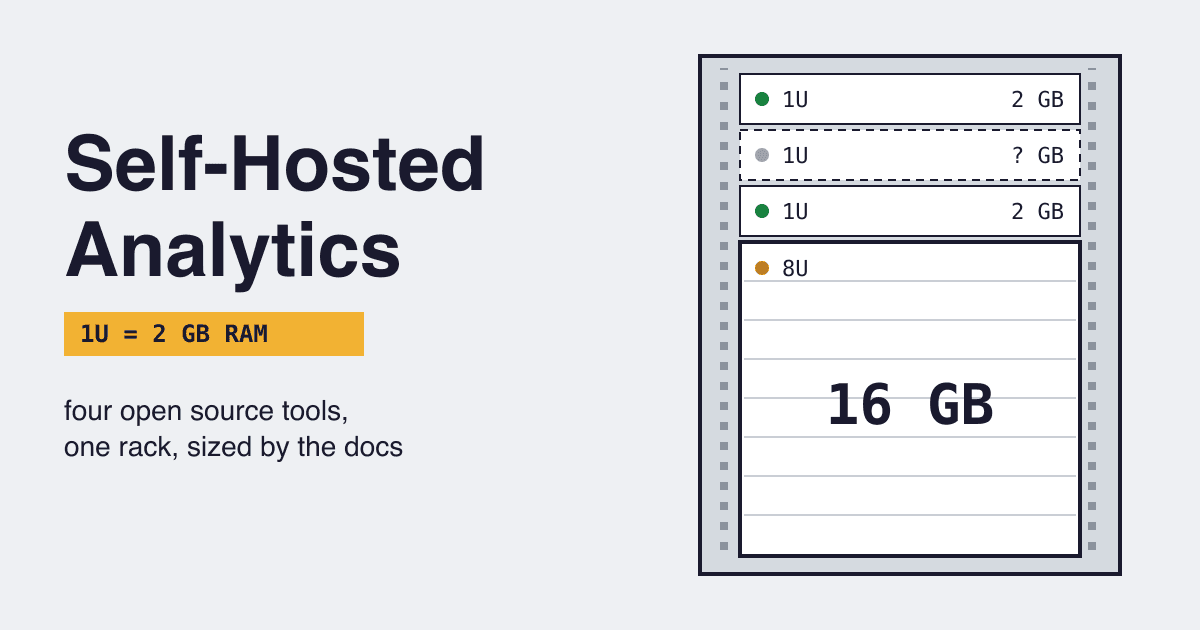
Between the lightest and the heaviest of the four open source analytics tools a small SaaS can run on its own server sits a factor of eight in memory: 2 GB against 16 GB, before a single pageview arrives. That number decides more than any feature list, so this page mounts all four in one rack: a spec matrix first, then one unit per tool, then the alarms each project prints in its own docs. Every figure was read from the project's own pages or measured on 13 November 2026.
The spec matrix
One row per fact, one column per tool. On a phone, scroll the table sideways.
| Fact | Plausible CE | Umami | PostHog (hobby) | Matomo |
|---|---|---|---|---|
| License | AGPL-3.0 | MIT | MIT, except the ee/ folder | GPL-3.0 |
| Smallest server the docs name | 2 GB RAM recommended | No size given | 4 vCPU, 16 GB RAM, 30 GB+ disk | 2 CPU, 2 GB RAM, 50 GB SSD (up to 100k pageviews a month) |
| Runtime and database | Docker Compose with ClickHouse and PostgreSQL (CPU needs SSE 4.2 or NEON) | Node.js 20.19+ and PostgreSQL 12.14+, or Docker | Docker Compose on one Ubuntu VM | PHP 8 and MySQL or MariaDB on any web server |
| Cookies by default | None | None | 1 cookie, 365 days, plus localStorage | 3 first-party cookies, the visitor ID kept 13 months |
| Tracker script, gzipped | 1.3 KB | 4.1 KB | 121.4 KB | 65.5 KB |
| Latest server release on GitHub | v3.2.1, 15 May 2026 | v3.5.0, 12 Nov 2026 | No versions: hobby builds are dated snapshots of master | 5.14.2, 22 Oct 2026 |
| Funnel reports | Cloud only, not in CE | Documented | Included in the free product analytics | Paid Funnels plugin |
| What self-hosters lose | Funnels, user journeys, revenue goals, SSO, sites API, premium support | No list published | Every paid-plan feature, and all vendor support | No list published; premium plugins are sold separately |
Tracker sizes: each project's hosted script fetched and compressed with gzip -9 on 13 November 2026, in kilobytes of 1,000 bytes. PostHog's figure is the full browser bundle from its US assets host and Matomo's is the copy its cloud demo serves, so both carry code a lean setup may not load.
Four units in the rack
Plausible Community Edition
1U · 2 GB
- RAM
- 2 GB recommended
- Databases
- ClickHouse + PostgreSQL
- Cookies
- 0
- Tracker
- 1.3 KB gzipped
- Releases
- Twice a year
The community edition README asks for Docker, a CPU that ClickHouse accepts and at least 2 GB of RAM "without fear of OOMs". Plausible's self-hosting page says it sets no cookies and collects no personal data, and that CE is a long-term release published twice a year, so new features reach cloud customers first.
Umami
1U · size not stated
- RAM
- Not published
- Database
- PostgreSQL 12.14+
- Cookies
- 0
- Tracker
- 4.1 KB gzipped
- Releases
- v3.5.0 shipped 12 Nov 2026
The install guide lists Node.js 20.19 or newer and PostgreSQL as the only database. The repository ships a Compose file that starts the app and Postgres together, and describes Umami as having no cookies. Of the four it is the one that runs as a plain Node.js process, which sits behind the reverse proxy you already have.
PostHog, hobby deploy
8U · 16 GB
- RAM
- 16 GB
- CPU
- 4 vCPU
- Cookies
- 1, kept 365 days
- Tracker
- 121.4 KB gzipped
- Scale
- A couple of 100k events
PostHog is more than page analytics: product analytics, session replay, feature flags and surveys come in the same app. The self-host docs ask for the equivalent of a 4 vCPU, 16 GB machine, and the disclaimer says a single-machine install is "unlikely to scale past a couple 100ks events without significant effort". By default the JavaScript library keeps a first-party cookie named ph_<project_token>_posthog for 365 days; setting persistence: "memory" stores nothing in the browser.
Matomo On-Premise
1U · 2 GB
- RAM
- 2 GB under 100k pageviews
- Disk
- 50 GB SSD
- Cookies
- 3 by default
- Tracker
- 65.5 KB gzipped
- Next size
- 4 CPU, 8 GB to 1M pageviews
Matomo's requirements page is the only one that sizes servers by traffic: 2 CPU and 2 GB RAM up to 100,000 pageviews a month, 4 CPU and 8 GB up to a million, and two servers past that. Its cookie FAQ lists _pk_id (13 months), _pk_ses (30 minutes) and _pk_ref (6 months) as defaults, and says the defaults can be turned off or replaced by cookieless tracking.
Alarms the spec sheets bury
- Plausible CE gets basic bot filtering. The cloud version excludes about 32,000 data center IP ranges; CE filters by user agent and referrer spam only, per Plausible. Expect more bot visits in a self-hosted dashboard.
- PostHog self-hosting has no versions and no support. Its docs say it publishes no CVEs, ships every fix from
master, and recommends staying on the latest image. The disclaimer adds that it cannot help recover lost data. - Umami starts with a known password. The first build creates the login
adminwith passwordumami, per the install guide. Since v3.5.0 Umami makes you replace it at first login, but until someone logs in, anyone who finds the instance can. Change it before the instance is reachable. - Cookies change your banner, not only your stack. Matomo's cookie FAQ says EU sites may need visitor consent for its default setup. A tool that sets no cookie by default is the shorter path to no banner, but check that with whoever advises you on privacy law.
- Self-hosting makes upgrades your job. Plausible's own page puts it plainly: a security fix only protects your instance once you apply the release. Watch the release feeds of Plausible, Umami and Matomo.
Which unit to mount
A landing page and a blog on a small VPS
Plausible CE or Umami. Both set no cookies and load a tracker under 5 KB. Umami fits next to an app that already runs Postgres; Plausible brings its own ClickHouse and Postgres in the Compose file.
You need funnels and revenue, self-hosted
Umami, whose docs cover funnel and revenue reports. Plausible keeps both out of CE, and Matomo sells Funnels as a premium plugin.
You want session replay and feature flags too
PostHog, if a 16 GB machine and no vendor support are acceptable. Past a few hundred thousand events its own docs point you to the cloud.
A WordPress site
Matomo has a WordPress plugin that installs it inside the site, mentioned on its requirements page.
How this rack was measured
Licenses come from each repository's LICENSE file (PostHog's keeps the ee/ folder under a separate license). Release dates come from the GitHub releases API on 13 November 2026. Server sizes, databases, cookies and missing features come from the pages linked in each unit, read the same day. No tool was benchmarked under load for this post.