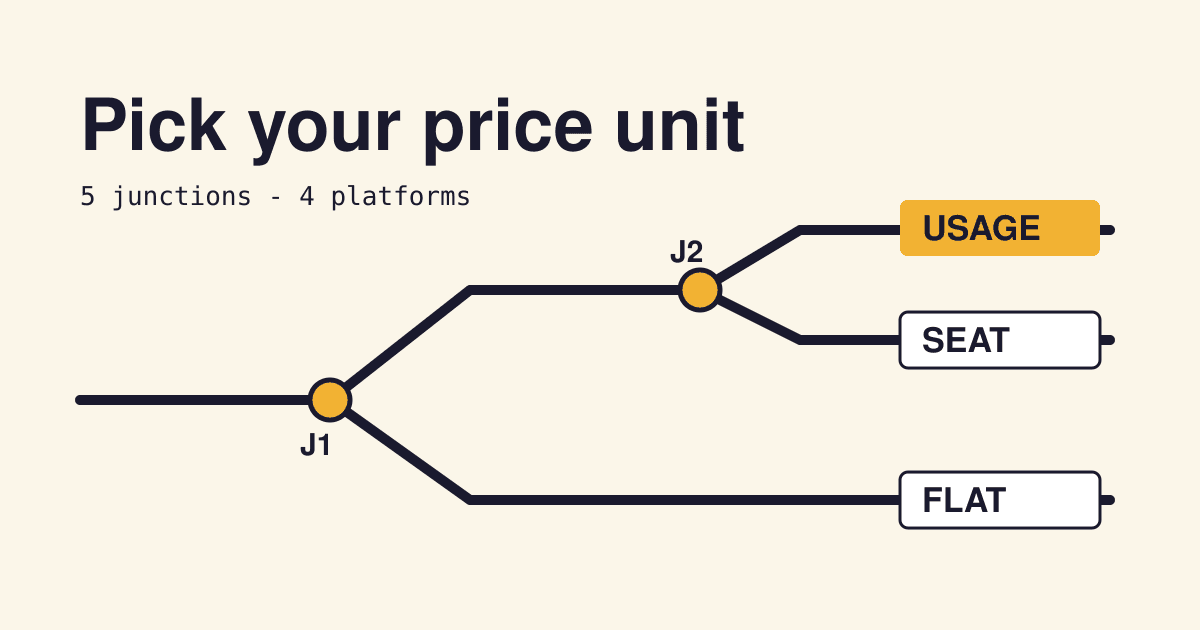
The unit you charge for decides who feels the bill, when it grows and what a customer must predict before they sign up, so pick the unit before you pick a number. This page is a route map: answer five yes or no questions in order, and each answer sends you to the next junction or to a platform with a pricing model. After the platforms come the free tier shapes that suit each one. Every example links to the vendor's own pricing page, read on 12 November 2026; prices change, so check them again before you copy one.
The five junctions
Does your cost grow with every request, event or gigabyte a customer sends?
If a heavy user costs you ten times what a light one does, a fixed price hands your margin to your biggest fans.
Yes: go to J2. Usage is probably part of your price.
No: go to J3. Your cost sits in people or features, not traffic.
Can a customer guess next month's usage within a factor of two?
Usage pricing is fair, but a bill nobody can predict stalls the purchase. Tailscale says it left per-active-user billing because customers told it that "led to unpredictable billing" (Tailscale pricing FAQ).
Yes: arrive at Platform U, usage-based.
No: arrive at Platform H, base plan plus usage: a fixed fee that includes a quota, with metered overage and a cap the customer controls.
Does the tool get more useful to a company as more of its people log in?
Collaboration tools gain value per person: an issue tracker with one user is a to-do list.
Yes: go to J4.
No: go to J5.
Do the buyers already count heads for every other tool they pay for?
Team leads budget per head, so a seat price fits the form they fill in. A seat that can be reused when someone leaves keeps it fair.
Yes: arrive at Platform S, per seat.
No: arrive at Platform H with a flat team fee and a generous seat count inside it.
Is it one person running the tool on their own machine?
A local tool costs you almost nothing per extra hour of use, and its buyer is often paying with their own card.
Yes: arrive at Platform F, flat fee: a one-off licence or a single subscription price.
No: arrive at Platform S, and revisit J1 once you know what a customer actually costs you to serve.
The four platforms
Platform U
Usage-based
Suits: APIs, monitoring, data and infrastructure, where cost follows volume.
Real example: Sentry's billing docs say it bills "based on the amount of data processed": each paid plan includes a monthly volume, such as 50k errors and 5M spans, and a pay-as-you-go budget the customer sets covers what goes over.
Watch for: what happens at the edge. Sentry states that data sent after the reserved volume and budget run out "will be dropped" and not charged, which means lost monitoring for the rest of the cycle. Say this on the pricing page, as it does, not in a support reply.
Platform S
Per seat
Suits: tools a team works in together every day.
Real example: Linear lists Basic at $10 per user a month and Business at $16, billed yearly. Tailscale charges per seat while user devices stay "free and unlimited", and a seat freed by someone leaving can be filled by the next person without a second charge.
Watch for: seat counting rules. Tailscale spells out that an invited user takes no seat until they first log in, and that a login with all seats full adds one seat, prorated. Write rules like these before your first invoice dispute, not after it.
Platform H
Base plan plus usage
Suits: products with both a team side and a traffic side, where buyers want a known number to approve.
Real example: Supabase Pro starts at $25 a month with quotas included (100,000 monthly active users, 250 GB egress) and a listed overage rate for each, such as $0.09 per GB of egress. Its spend cap is on by default on Pro, so going over the quota needs a deliberate switch.
Watch for: too many meters. Each extra meter is one more line a buyer must model before approving the purchase.
Platform F
Flat fee
Suits: desktop apps, CLIs and libraries run by one person.
Real example: Sublime Text sells a personal licence as "a once off purchase" with 3 years of updates, after which an upgrade is needed for further updates; the editor can be evaluated for free first.
Watch for: revenue that stops when sales stop. A paid upgrade window, like those 3 years, is how a one-off price keeps paying for maintenance.
Free tier sidings: what to limit
A free tier is a siding off the main line: a place where people can wait for free until something pushes them onto the paid track. The limit you choose decides what that push is. Pick the limit that grows with the value the customer gets.
Limit the volume
Fits Platform U and H. Supabase Free includes a 500 MB database and 5 GB egress, with a limit of 2 active projects.
Limit the work stored, not the people
Fits Platform S. Linear Free allows unlimited members but 250 issues and 2 teams, so a whole team can try it, and a real project pushes them to pay.
Limit the kind of use
Tailscale's Personal plan is free for non-commercial use and allows 6 users; a tailnet created with a custom domain counts as business use and starts a 14-day Enterprise trial instead.
Limit the time
Fits Platform F and big plans. Sentry gives a 14-day Business trial with unlimited event data, then drops an account without a paid plan onto the free Developer plan rather than locking it.
Limit idle cost
Supabase pauses free projects after 1 week of inactivity; paid projects are never paused. An abandoned free account then stops costing you compute.
One table to check your route
| Model | Bill grows with | Free tier limits | Example |
|---|---|---|---|
| Usage | Events, data, requests | Volume per month | Sentry |
| Per seat | People who log in | Stored work or teams | Linear, Tailscale |
| Base plus usage | Plan, then quota overage | Volume and project count | Supabase |
| Flat | Nothing; upgrades later | Free evaluation | Sublime Text |
Sources
- Linear, Pricing, read 12 November 2026.
- Supabase, Pricing, read 12 November 2026.
- Sentry, Pricing and Sentry Docs, Pricing and Billing, read 12 November 2026.
- Tailscale, Pricing and FAQ, read 12 November 2026.
- Sublime HQ, Buy Sublime Text, read 12 November 2026.