We use analytics cookies to see how the site is used. They are only set if you accept. Accepting also turns on session recording (pages viewed, clicks and scrolls) so we can fix problems; what you type stays hidden. It also lets Meta (Facebook) see your visit, so we can measure our ads. Read the privacy policy
Your Product Updates Page Is a Landing Page You Already Wrote. Stop Hiding It.
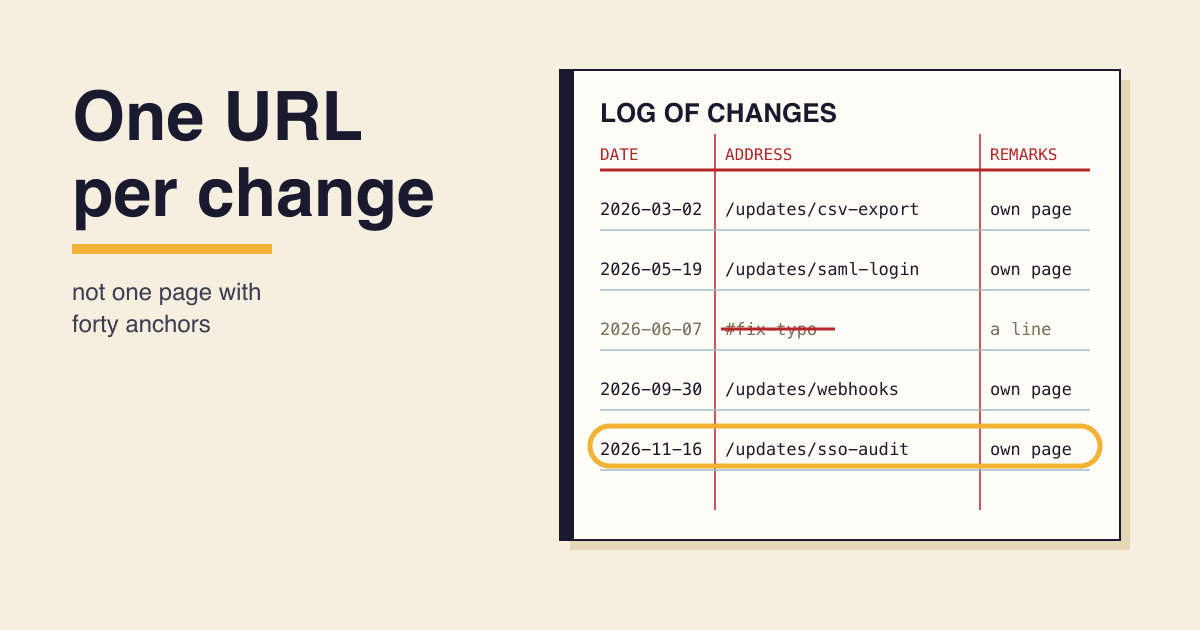
An opinion: a changelog that lives on one endless page behind a "load more" button throws away the best writing a small team does. Give every notable change its own dated URL and the page starts earning visits.
By CodeTrendy Editorial TeamPublished Reviewed
Small teams write their clearest prose on the day they ship something, and then they file it where nobody outside the product will ever find it. The usual updates page is one long scroll: every entry stacked under the last, linked by a #v2-4 anchor, older entries tucked behind a "Load more" button. It reads fine for a customer who already has the tab open. For anyone arriving from a search engine, it barely exists.
My position is simple. A changelog is a growth channel only when each notable change is a page of its own: its own URL, its own title, its own visible date. Everything else here is the reasoning, the rules I would keep, and the objections I take seriously. The search behaviour I cite comes from Google's own documentation, read on 13 November 2026.
Anchors are not addresses
Entry 01Course: stop relying on the hash
Google's URL guidance says it plainly: do not use fragments to change the content of a page, because Google Search generally does not support URL fragments. Its pagination guidance goes further and says Google ignores fragment identifiers. So /changelog#dark-mode and /changelog#sso are, to the crawler, the same page with the same title.
That matters because the people searching for your change do not search for your product's changelog. They search for the thing the change does: "export to CSV", "SAML login", "webhook retries". One page titled "Changelog" with forty features on it can only be a weak answer to forty different questions. Forty pages, each titled after one change, can each be a strong answer to one.
The same pagination page says Google generally crawls the URLs found in the href of <a> elements, and that its crawlers do not click buttons and generally do not trigger JavaScript that needs a user action. A changelog that only reveals last year behind a button has, for search purposes, no last year.
The fix is boring, which is why I like it. Keep the index page if your customers like scrolling, but give it real paginated links (?page=2, each page with its own canonical, as the same guidance recommends) and link every entry on it to that entry's own page.
A changelog entry is news with a shelf life, and a reader deciding whether your product still has the bug they hit needs to know when the fix landed. Google's byline date guidance asks for the same thing: a user-visible date labelled "Published" or "Last updated", the same date in datePublished or dateModified of the page's structured data, and no future dates or dates of the event described.
Keep a Changelog arrived at the same rule from the human side: the release date of each version is displayed, written as 2017-07-17 so nobody confuses month and day. When the people rule and the crawler rule agree, I stop arguing and follow both.
Most changelog tools and blog engines emit an RSS or Atom feed. Google's sitemap documentation says it accepts RSS 2.0 and Atom 1.0 feeds as sitemaps, with one caveat worth knowing: a feed only tells Google about recent URLs. So submit the feed for freshness and keep a normal XML sitemap for the archive. If you publish through GitHub Releases, each public repository already serves an Atom feed at /releases.atom; I checked one on 13 November 2026 and it answered with application/atom+xml.
The same page also notes that Google ignores <priority> and <changefreq> and uses <lastmod> only when it is consistently accurate. A build that stamps every changelog URL with today's date on each deploy teaches Google to ignore your dates.
Write the entry for the person, then give it a page
Entry 05Course: notable changes only
Here is where I part ways with teams who hear "SEO" and start publishing a page per commit. Keep a Changelog defines a changelog as a curated list of notable changes and calls commit log diffs a bad idea because they are full of noise. Google's helpful content questions point the same way: does the page give original information, does its title describe it without exaggerating, would someone bookmark or share it?
A typo fix fails every one of those tests. A new export format, a breaking API change, a price change or a security fix passes them. My rule of thumb: an entry earns its own URL when a stranger could search for what it does, or when a customer would link to it in a support thread. Everything else stays a line on the index page.
Kind of change
Own page?
Why
New capability a stranger would search for
Yes
It answers a query nobody else on your site answers.
Breaking change or deprecation
Yes
Customers link to it; Keep a Changelog says list these if nothing else.
Security fix
Yes
People search the advisory and need the date and version.
Keep it. The index page and the entry pages are not rivals: the index links to every entry, and every entry links back. The scroll stays for customers, the URLs exist for everyone else.
"Our changelog tool does not support separate pages."
Then the tool decides how findable your work is. Check before you pick one: does each entry get a crawlable URL without JavaScript, a title of its own, a visible date and a feed? If not, a plain folder of Markdown pages on your own site does all four.
"Nobody searches for changelogs."
Agreed, and that is the point. They search for features, fixes and errors. A page titled after the feature, written on the day you built it, is a reasonable answer to that search. A page titled "Changelog" is not.
"This will create a lot of thin pages."
Only if you give a page to every line. The rule in entry 05 exists for that: a page per notable change, a line for the rest.
The course I would set
Entry 07Course: the whole plan on one card
One URL per notable change, titled after what the change does, not after the version number.
A visible "Published" date on every entry, matched in structured data, never restamped on deploy.
An index page with real <a href> pagination, no button-only history.
The feed submitted as a sitemap for fresh entries, an XML sitemap for the archive.
Small fixes as lines, not pages, so every page you publish deserves the visit.
None of this costs a new channel, a new writer or a budget. You already write the words on ship day. Give them an address and let people find them.